
Introduction
The Indian law does not confer proprietary rights over an advertising idea merely because a brand or creator used it first. Protection begins where the idea assumes identifiable expression through films, photographs, scripts, visual composition, sequencing, music, graphics and other creative choices, and may become stronger where campaign elements acquire source significance, goodwill, or are protected by confidentiality and contractual rights.
I. The Line Call: When does inspiration become copying?
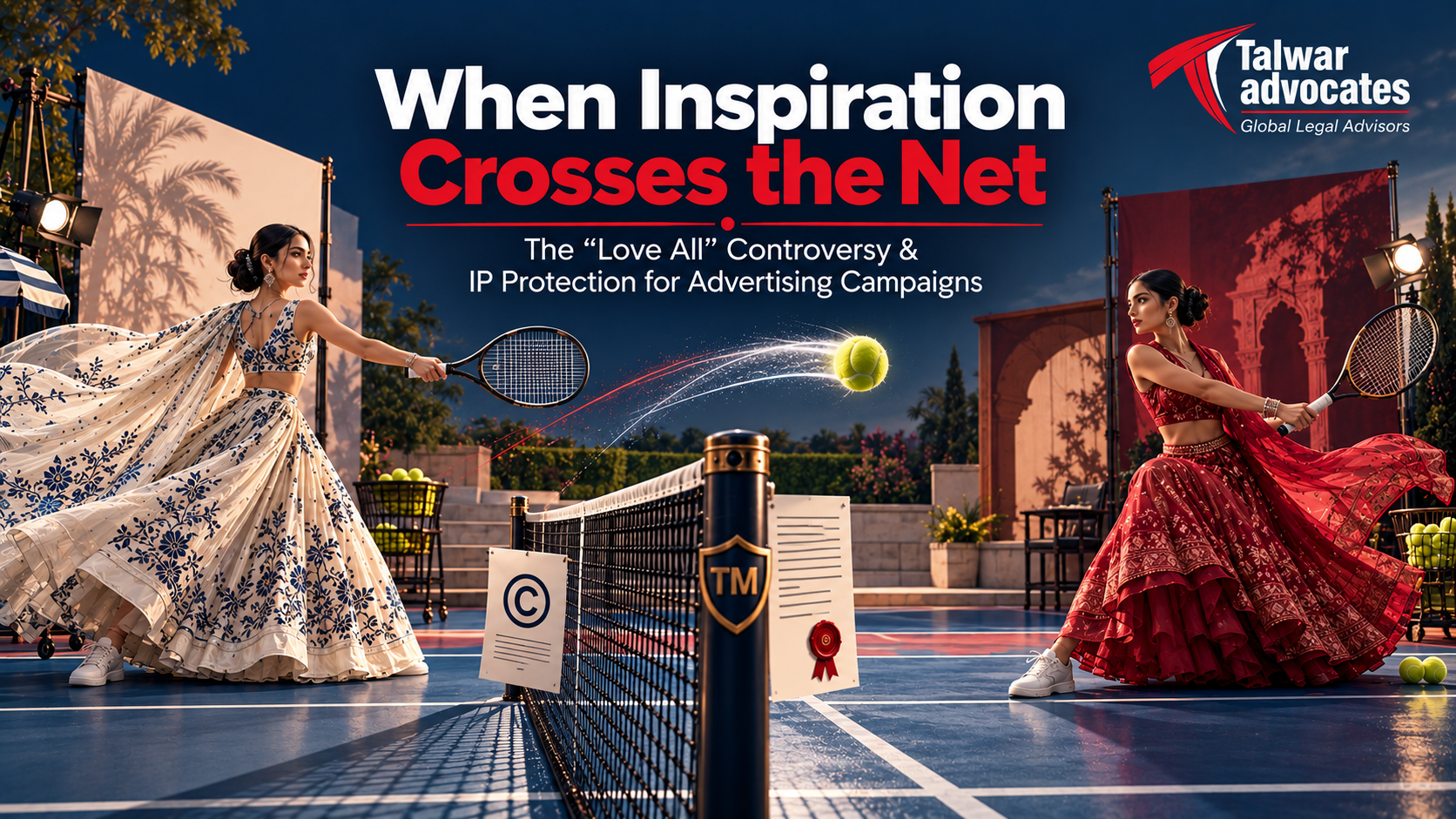
One campaign. Two independent designers. A question of originality. What is the Anita Dongre “Love All” Controversy all about?
Anita Dongre launched the Love All FW 26 campaign in August 2026.
Mehar Toor of Ada by Mehar, and Sachi Raval of Same Sisters subsequently identified similarities with their earlier campaigns. The alleged overlaps concerned tennis as the theme, Indian fashion photographed against tennis imagery, visual compositions, and the phrase “Love All”.
In Raval’s case, there was also an allegation that material relating to her earlier work had previously been shown to or acknowledged by someone connected with Dongre’ creative team.
However, neither designer simply framed the matter as proven plagiarism. Mehar Toor reportedly distinguished “inspiration” from outright copying; whereas Raval acknowledged that tennis, Indian fashion and “Love All” could independently occur to different creators. Dongre maintained that her campaign was independently conceived over several months and described the situation as one of “overlapping creative expressions”.
The question is: When does a creative campaign cease to be merely an idea available to everyone and become sufficiently expressed, distinctive or source-identifying to constitute protectable intellectual property?
The article examines the controversy as a legal study; it does not suggest that infringement has been established.
II. Campaign Advertisement: A Set than a Shot
Campaign advertisement is not one monolithic copyright; it is a set of creative elements. It is better understood as a portfolio or bundle of potentially overlapping rights than a single species of intellectual property.
As discussed at detail in the sections ahead, a campaign advertisement is a combination of various IPRs, statutory, and contractual rights, including legal or remedial actions beyond a straightjacketed copyright violation or trademark infringement. A campaign is best protected when dissected into different elements, wherein the creative and artistic parts are covered under the copyrights; the brand identifiers are protected under trademark law; acquired goodwill and consumer associations is protectable through passing off actions; and any remaining gaps are filled up by concrete contracts and agreements that also extended added rights and obligations, such as ownership, use, and confidentiality.
III. The Baseline: You Cannot Copyright the Tennis Court
Copyright does not give the first advertiser ownership of the playing field; it may, however, protect the choreography with which that advertiser played upon it.
In R.G. Anand v. Delux Films (1978), the Supreme Court proposed a test for the idea-expression dichotomy in copyright:
- No copyright protection in an idea, theme, subject matter or plot;
- Copyright attaches to the form, manner, arrangement and expression of that idea;
- Similarities flowing naturally from a common idea are not enough;
- The relevant enquiry is whether substantial or fundamental aspects of the earlier expression have been reproduced.
- The overall impression is left upon a viewer who has been both works.
How these relate to the controversy at hand can be looked at in terms of what is protectable, and what is not:
A. Out of Line (Not protected)
Everything at the level of “idea” is not protectable such as—
- Indian fashion with Tennis
- Tennis Court
- Tennis Racquet
- Tennis Net
- Models playing Tennis
- “Love All”- due to its relevance to Tennis-connotation
B. In the Line (Protectable)
Everything that is an independent expression of an idea such as—
- Specific layout and positioning of models
- Specific poses
- Specific camera angles
- Specific framing
- Connection between the apparels and tennis props
- Lighting, colour palette, graphic treatment
- Sequence of shots, transitions, editing rhythm
- Recurring combinations of these features
Therefore, a brand cannot monopolise “tennis and fashion”, but the particular creative expression through which the concept is brought to life may be protectable.
IV. THINK PINK: THE AMERICAN TRYST WITH COLOUR MARKS
The convergence point of campaign protectability is best illustrated through judicial precedents and other similar ongoing disputes.
Bright Lifecare Pvt. Ltd v. Vini Cosmetics Pvt. Ltd. (2022)
The Delhi HC herein asked whether an advertising campaign and its various elements can receive IP protection.
Bright Lifecare’s MuscleBlaze launched a “ZIDDI HOON MAIN” (Translation: I am stubborn (positive connotation)) campaign involving elements including the “ZIDD/ZIDDI” (Translation: perseverance, determination) theme, a dark gym atmosphere, colour treatment, muscular protagonists, ropes and punching bags and associated presentation. MuscleBlaze alleged that Vini Cosmetics’ “Realman” advertisement had copied elements of its “ZIDDI HOON MAIN” campaign.
The Court recognised that creating a campaign involves a concept, story, creative direction, visual treatment, script, shoot, edits, music, and brand integration. However, the Court did not say that MuscleBlaze owned the idea of “workout, perseverance, and muscular men”; it considered the significance of the entire selection and expression of otherwise potentially commonplace ingredients—such as the similarity in visual setting, scenes, colour treatment, overall look and feel, expression, concept, etc.
The Court emphasised that each alleged copied element should not be microscopically dissected, rather the overall effect of such elements upon the ordinary viewer should be considered for judicial enquiry. Individual building blocks may be common, but their distinctive combination may not be.
Hence, the Court held that although the underlying ideas cannot be monopolised, the expression incorporated into an advertising campaign can be protected. The two impugned commercials were ultimately restrained in their existing form by the Court and were permitted modification to remove the objectionable similarities.
Applying this decision to the “Love All” controversy, it can be said that a brand cannot monopolise the idea of “tennis + fashion”; however, another brand cannot simply reproduce the creative expression through which you brought that idea to life.
V. The Added “Advantage”: Trademark Protection for Tagline or Campaign Name
Indian judiciary has recognised that slogans and taglines can become powerful brand identifiers. Hence, trademark law can provide a second layer of protection. A campaign name, slogan or tagline may potentially function as a trademark where it is distinctive and identifies a commercial source. However, as a precondition to registrability, such taglines or slogans should not be descriptive or laudatory in nature.
How Indian courts have approached the question of trademark protection for taglines can be best illustrated through these decisions:
1. GlaxoSmithKline (GSK) Consumer Healthcare v. Abbott Healthcare (2008)
GSK had alleged that Abbott’s PediaSure advertisement adopted an ending comparable to its ‘Horlicks’ “Taller, Stronger, Sharper” campaign. GSK argued that its slogan and campaign had become so closely associated with Horlicks that imitation would cause consumers to associate PediaSure with GSK.
The Calcutta HC recognised that passing off is capable of extending beyond a conventional trademark, to slogans, visual images, and even advertising campaign, where advertising has given the product, a distinctive character recognised by the market.
However, the Court simultaneously warned against using passing off to monopolise generic advertising propositions. Because “taller”, “stronger” and similar claims were closely connected with the ordinary attributes that a nutritional-drink advertising would naturally emphasise. Nevertheless, the Court did reemphasise an idea or a theme may remain free, however its expression if copied by another is actionable.
2. PepsiCo Inc. v. Parle Agro Pvt. Ltd. (2023)
PepsiCo alleged infringement by Parle of its registered tagline “For The Bold”, used for its ‘DORITOS’ chips. Parle challenged the validity of PepsiCo’s registration, arguing that ” For The Bold” is a common descriptive phrase and lacked distinctiveness. The Delhi HC found the validity challenge to be tenable; however, the Court did restrain Parle from using “For The Bold” as the dominant or predominant element of an advertising campaign pending the proceedings.
IV. A Shot at ‘Passing Off’: Understanding Action IN Court
Even without registration, a campaign can potentially acquire a distinctive commercial identity. Consumers may begin associating visual identity, slogans, characters, look and feel, recurring elements with a particular product. What happens where a campaign name, visual identity or recurring creative treatment is not registered as a trademark or is too weak to attract copyright protection by itself, but consumers have nevertheless come to associate it with one particular business? That is where passing off may become relevant.
However, similarity by itself is not enough for passing off; goodwill, misrepresentation and a resulting damage due to the same shall be established.
A notable difference between copyright claim and passing off action is that copyright requires proving the copying of protectable expression, whereas, passing off requires proving a strong association between a commercial aspect with a singular source that subsequent use of the same/similar aspect by another misrepresents connection with the original source.
Applying the concept to “Love All”, a passing off action will not permit monopolising: tennis as a concept; a tennis court; Indian clothing; tennis imagery; “Love All” itself. Instead, the claimant would need to prove that some relevant campaign identity has become associated in the public mind with its business.
Elements of Passing Off
Goodwill is evidenced through sustained use; consumer exposure; online reach; media coverage; advertising expenditure; social media engagement; consumer recognition; sales connected with the campaign etc. However, mere priority does not establish goodwill; while prior use is useful evidence, proving market recognition and association are primary requirements. However, consumer recognisability alone does not translate into passing off, a relevant legal misrepresentation, or likelihood of confusion or association should be present.
Misrepresentation is centred around a primary question—whether the later presentation is capable of making consumers believe there is some commercial connection, association, sponsorship, extension or common source. Passing off is not confined to someone putting another person’s exact logo on their product. A sufficiently distinctive campaign identity can potentially generate a false impression of commercial association.
To illustrate further, it is pertinent to look at the following decision:
Hindustan Unilever Ltd. (HUL) v. RSPL Ltd. (2025)
HUL (owner of Surf Excel detergent brand) sued RSPL (owner of Ghadi detergent) alleging disparaging advertisements. HUL argued that RSPL’s advertisements indirectly identified Surf Excel with using blue packaging, the expression “XL Blue” and wording resembling Surf Excel’s popular “Daag Acche Hai” (spots are good) campaign. RSPL responded that HUL had no monopoly over “Excel” or blue packaging and that similar packaging was common in the detergent market.
Viewing the commercials from the perspective of an ordinary consumer, the Court found prima facie that the competitor being referred to could reasonably be understood to be Surf Excel. The Court did not prohibit the entire advertising campaign but directed RSPL to remove the derogatory expressions from the commercials and permitted the advertisements to continue only after those modifications were made.
Damage is the final limb of passing off, which includes damage to goodwill. It follows from a misrepresentation and covers not only an actual confusion, but also where likelihood of confusion and threatened injury are otherwise sufficiently established.
Will Love All Succeed at Passing Off?
A campaign does not become protectable under passing off merely because it is original or because it came first. The claimant must show that the campaign, or relevant elements of it, have acquired goodwill and source significance in the market. If a later campaign, then adopts those source-identifying elements in a manner likely to suggest a commercial connection, passing off may supplement copyright and trademark remedies. Mere visual similarity, inspiration or chronology, without goodwill and misrepresentation, is insufficient.
Therefore, Love All cannot simply be treated as proprietary because Same Sisters used it in 2023. It is an ordinary tennis expression. So, a claim attempting to monopolise those words alone would face obvious difficulties. A stronger passing off case based on appropriate evidence would rather be when it is proved that Love All coupled with the tennis x Indian fashion campaign identity has acquired such goodwill and source recognition that the relevant public associates that combination with Same Sisters only. Merely suggesting that the relevant public might think that Anita Dongre was inspired by Same Sisters would qualify as passing off.
What needs to be proved substantially is that consumers associated the campaign identity so strongly with Same Sisters, a latter similar adoption by another brand is likely to make the consumers believe that there is a collaboration, license, commercial association, common source, brand extension, endorsement or some other business connection.
VII. The Ravaging Rally: What if the Later Creator had Already Seen the Earlier Campaign?
In the Love All Controversy, the elements of access, confidential pitches and creative-agency relationships are a moot point, especially in context of Sachi Raval’s “Same Sister” campaign.
Zee Telefilms Ltd. v. Sundial Communications Pvt. Ltd. (2003)
Sundial Communications developed a television series concept based on a child incarnation of Lord Krishna entering a troubled family and resolving their problems through divine interventions. Sundial developed the concept into detailed notes, character sketches, episode plots and a pilot episode. The concept was presented to Zee Telefilms for possible production with an understanding that the material was confidential. Subsequently, Zee announced a television series titled “Kanhaiyya”; Sundial alleged the announced series was substantially based on its original concept, and filed copyright infringement, breach of confidentiality, and passing off proceedings against Zee.
The Bombay HC distinguished copyright from breach of confidence. The Court recognised that copyright does not protect mere ideas, themes or concepts; however, when an idea is developed into detailed expression as performed by Sundial, such expressions may receive copyright protection. The protection was not granted for the idea of a child Krishna helping a family, but for the particular manner in which the concept was developed and expressed.
The Court further found that Sundial had disclosed its concept to Zee in circumstances where Zee was expected not to exploit the material independently. The absence of a formal non-disclosure agreement did not defeat the claim because confidentiality obligations may arise from the circumstances of disclosure.
Therefore, the Court held that an idea or developed creative proposal communicated in circumstances of confidence may receive protection through law even where copyright principles alone would not protect the abstract concept.
Hence, the Court applied the test of an ordinary viewer, and held that after seeing both works, such viewer might receive the impression that the later creation is substantially derived from the earlier work.
The Court concluded that Zee unlawfully exploited Sundial’ original work which amounted to copyright infringement.
Applying this case to Love All, it is imperative to highlight that ‘access alone is not infringement’. In the Sachi Raval tangent to this Controversy, a 2023 Instagram campaign was already out in the public. Therefore, a breach of confidence would be considerably more difficult to prove unless unpublished material was separately communicated.
VIII. Grand Slam Strategy for Campaign Advertisement Protection
Contemporary advertising campaigns are seldom protectable under a single realm of Intellectual Property Rights. Multiple legal mechanisms are employed to provide a holistic IP protection.
In case of campaign advertisement, there are a number of IPRs and commercial protective layers at play. They are discussed further in detail as under:
The elements of an advertisements contained and compiled as photographs, films, artwork, scripts, graphics, music, visual content are covered and protectable as copyrights. Although copyrights exist at the instance of creation, and their registration is not mandatory, however, it is suggested that relevant registrations be secured for them.
When it comes to campaign names, campaign slogans, brand taglines, brand logos and marks, brand identifiers, trademark law is the appropriate IP branch to secure these identifiers.
Repeated use of distinct identifiers creates goodwill for brands, strengthens commercial identity, and builds consumer association in the market. These elements are best protected through a passing-off action, should another entity damage the acquired goodwill through consumer confusion.
Wherever gaps remain in the legal layout of IPs, brands employ robust and leakproof contract regime. In filming and advertising industry, contracts serve an extended purpose of clearly defining and determining the ownership of creative assets and associated intellectual properties that are generated as consequence of an entire advertisement. Due to a number of vendors and independent artists involved in the production of a campaign, it is highly imperative to clearly demarcate that the resultant intellectual property, and the campaign is owned by and operated by the campaigning brand only, unless any agreements to the contrary exist.
Additionally, there are certain rights that do not arise from intellectual properties alone however, they do arise out of contractual obligations intended to provide an added layer of protection to intellectual properties. For example: confidential obligations, future-use rights, ownership of source files, ancillary creative record, deleted scenes, raw footage, etc.
Therefore, a brand paying for a campaign does not automatically mean it owns every underlying creative asset, a robust contract regime to that effect secures the same.
Although at present, there is no operative legal dispute on the Love All Controversy, however, should a legal dispute arise due to further developments, it would not be erroneous to state that the campaign may have begun at a tennis court; the dispute may end in a court of law.
IX. What Should Brands do Before Serving a Campaign?
Learning from this Controversy, it is affirmative that IP protection starts even before the campaign goes public. Therefore, it becomes extremely crucial for brands to actively undertake protective measures under a variety of protection channels.
For securing the relevant copyrights, it is suggested that the brands document the entire creative development process; preserve dated concept notes, drafts, sketches, and storyboards (whether finalised or not); and properly evidence and record approvals and creative references from respective artists/creators/owners.
In order to secure trademark protection, it is recommended that clearance searches be conducted for proposed names, logos, and taglines associated with the campaign; preserve any evidence of first use and market recognition of a name, tagline, motto etc.; and register important campaign names and taglines as trademarks where appropriate.
Any potential conflicting claims are best mitigated through execution of bulletproof IP agreements with the associated agencies, artists, freelances, vendors, etc. Such agreements must ensure continued confidentiality and clearly determine the ownership of ancillary production materials.
The most solid and secure IP protection strategy begins with a simple annotation—know what you own.

Leave a Comment