
Introduction
When you walk down a supermarket aisle, you rarely need to read the label to identify a milk chocolate. The distinctive shade of purple is often enough. Likewise, when you look for coconut oil, a navy-blue bottle is enough for you to locate it. In these instances, colour is not solely a branding element but a part of its identity, enabling consumers to associate a particular colour with a product.
It all started in 1985, when Owens-Corning, a fiberglass company, became the first company in American history to successfully trademark a colour. Ten years later, the US Supreme Court in Qualitex Co. v. Jacobson Products Co. (1995) put colour marks on the world map. Unlike words, logos, or symbols, when a specific colour or a combination of colours becomes inherently associated with a brand that consumers immediately think of when they see it, it can be registered as a colour trademark. It is one of the most successful non-traditional trademarks where at least one colour is associated with a product’s unique commercial identity.
Indian law arrived at a similar, albeit more cautious position, recognising colour trademarks under Section 2(1)(m) of the Trade Marks Act, 1999 (hereinafter referred to as the “Act”), which incorporates colour combinations under the definition of a mark, and Section 10, which contemplates registration of trademarks that are limited wholly or partly to particular colours. Such registration hinges on brand distinctiveness and non-functionality of the associated colour.
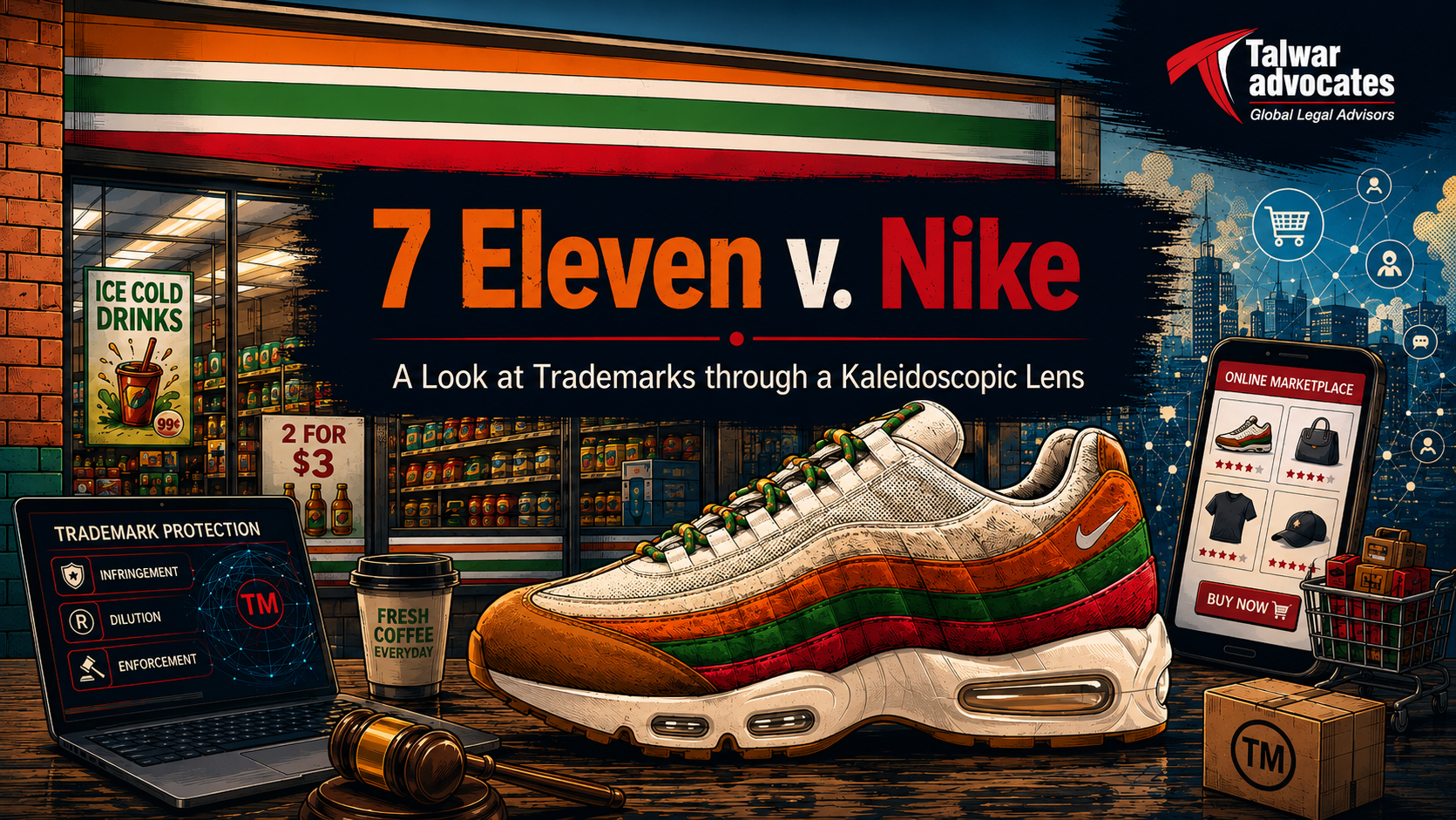
An exemplar of colour trademarks is playing out halfway across the world in Texas, where a lawsuit filed by 7-Eleven against Nike has been making headlines, alleging that its orange, green, and red ‘Tri-Colour Mark’ has been lifted, stripe-for-stripe, for a shoe. It is as good a starting point as any to ask a deceptively simple question: can a business really own a colour?
WHAT MAKES A COLOUR A TRADEMARK?
Trademark law exists to protect the identity of a brand and the ability of a consumer to look at a mark and recognise, without confusion, where a product comes from. A colour is usually an attribute of a product. It has no inherent capacity to indicate the origin of a product like a swoosh mark indicates Nike or a large yellow M on a red background indicates McDonald’s. For a colour to morph from being ornamental to a trademark, it must establish two requisites:
- Acquired Distinctiveness: Through consistent and substantial exclusive use, the colour should have come to be associated with a single commercial source in the minds of consumers, rather than being common. This is rarely presumed and must be proven with evidence and a specific Pantone shade.
- Non-functionality: The colour cannot serve a utilitarian or competitive purpose that other traders would necessarily need to use. For example, red is not registrable for fire extinguishers; a surgical colour like green or blue is unlikely to be registrable for medical scrubs. If competitors have a genuine need to use that colour, granting exclusivity would distort the market rather than protect a brand.
These two requirements form the reason for the wary treatment of colour marks as compared to conventional marks. A word mark can be arbitrary or invented from the litany of words available. Colours, by contrast, are a limited resource and may get exhausted if many exclusive claims over individual colours are made, leaving no colours left for new entrants. Perhaps, it is due to this concern that Indian law recognises colour combinations but avoids single-colour trademarks.
THE INDIAN STATUTE
Section 2(1)(m) of the Act defines a “mark” inclusively, listing a device, brand, label, name, signature, shape of goods, packaging, and “combination of colours” among the things capable of being a mark. Section 2(1)(zb) then defines a “trade mark” as a mark capable of graphical representation and distinguishing one trader’s goods or services from another’s.
Section 10(1) permits a whole or part registration of a trade mark on account of a particular combination of colours, provided it is distinctive. In the case where no such colour combination is specified, Section 10(2) provides that the mark is deemed registered for all colours.
These provisions when read in conjunction with the absolute grounds for refusal in Section 9, specifically, the bar on marks devoid of distinctive character, the framework appears permissive in principle but remains demanding in practice, a distinction that will be elucidated later on in this piece.
STRIPES ON TRIAL: THE 7-ELEVEN V. NIKE LAWSUIT
The dispute itself is a textbook illustration of what colour trademarks are meant to protect. Nike had scheduled the release of a new Air Max 95 ‘Big Bubble’ sneaker in ‘Sport Green and Safety Orange’ colours, and it chose July 11, 2026 (also known in the United States as ‘7-Eleven Day’) as the launch date. 7-Eleven filed suit in the US District Court for the Northern District of Texas on July 01, 2026, alleging that the shoe’s orange, green, and red side striping was a “confusingly similar imitation” of its own Tri-Colour Mark, a combination that 7-Eleven has used in various forms for close to six decades and which is the subject of a federal registration.
The complaint does not rest on colour alone. It has also been alleged that Nike and 7-Eleven had collaborated in the past for a product that never reached the shelves—a 7-Eleven x Nike SB Dunk Low planned for the Tokyo Olympics, which was shelved due to the Pandemic. Presently, the matter remains pending.
Whatever the Texas Court eventually decides, the case remains a live example that colour disputes are rarely about colour in isolation. They are about a specific visual identity, built over years and bolstered through advertising and branding, that a business believes has been appropriated by another, to borrow its goodwill.
THINK PINK: THE AMERICAN TRYST WITH COLOUR MARKS
The United States has, by some distance, a more advanced body of law on colour marks. The inception of colour marks started when Owens-Corning, which had been dyeing its fibreglass insulation pink since the 1950s, purely to distinguish it from its ‘naturally tan’ rivals and claimed distinctiveness over the colour. Over three decades, the company built an entire identity around the colour: the slogan “Think Pink,” the Pink Panther as its mascot, and tens of millions of dollars in advertising. When it sought to register the colour itself, the trademark examiner and the Trademark Trial and Appeal Board initially refused, worried that this would deplete the palette available to competitors. On appeal, the Federal Circuit disagreed, holding in In re Owens-Corning Fiberglas Corp. (1985), that where there is no genuine competitive need for a colour, refusing registration on a generalised fear of depletion is unreasonable. Pink insulation had, on the evidence, become synonymous with one company alone, and it became the first single colour ever registered as a trademark in the United States.
A decade later, the question reached the Supreme Court in Qualitex Co. (1995) where Qualitex had used a distinctive green-gold shade on its dry-cleaning press pads for decades when a rival, Jacobson, began using a near-identical shade. Qualitex sued for infringement. The Court of Appeals for the Ninth Circuit set aside a trial court win for Qualitex, holding that the Lanham Act simply did not permit registering colour alone. A unanimous Supreme Court reversed this judgment. It held that the Act’s language was wide enough to encompass colour, Qualitex’s green-gold combination had acquired a distinctive secondary meaning, and that the colours served no function beyond identification. Thus, the Court said that colour could be treated no differently from any other symbol capable of indicating source, provided the ordinary requirements of distinctiveness and non-functionality were met.
These two cases opened the door to a familiar roster of American colour marks, each carved out narrowly for a specific class of goods or services rather than granted at large:
- Tiffany & Co.’s robin’s-egg blue (Pantone 1837, a nod to its founding year), registered for jewellery packaging;
- UPS’ “Pullman Brown,” in use since 1916 and protected for delivery vehicles and uniforms;
- T-Mobile’s magenta, adopted by its parent Deutsche Telekom around 2000 and defended aggressively against telecom rivals;
- John Deere’s green-and-yellow combination for agricultural equipment;
- Mattel’s Pink associated with Barbie;
- Christian Louboutin’s Chinese Red soles associated with the brand forming a distinct identity, fiercely protected against competitors.
These brands are not similar because they hold a colour trademark; rather, they accumulated decades of exclusive use, extensive and consistent advertising, and a class of goods narrow enough that a real, provable association could form. That combination of ingredients is exactly what a company suing over shoes’ stripes, or registering a purple wrapper for a chocolate, must demonstrate in the United States of America to register a colour trademark.
RED SOLES AND RED HERRINGS: INDIA’S COLOUR-CODED COURTROOMS
If the American story is one of steady acceptance, the Indian story is one of genuine ambivalence and is best narrated in the saga of Christian Louboutin’s red sole.
Louboutin holds an Indian registration for its “RED SOLE” mark and has litigated to enforce it more than once, with strikingly inconsistent results. In an early round, a single judge of the Delhi High Court recognised the red sole as a mark that deserves protection. In a later suit, Christian Louboutin SAS v. Abubaker (2018), a different single judge took the opposite view, holding that a single, standalone colour, and not as a combination, falls outside the statutory purview of a “mark” under Section 2(1)(m), which explicitly mentions a “combination of colours.” Louboutin argued that Qualitex should guide the Indian Court toward recognising single-colour marks, but the judge declined, reasoning that India had to be governed by its own statute rather than by a foreign court’s reading of a differently drafted American law. Going for a third round the following year, a Division Bench allowed Louboutin’s appeal, but largely on procedural grounds. The substantive question of merits, whether a single colour can be registered as an Indian trademark, was left unresolved even as Louboutin ultimately prevailed and later recovered damages from other infringers.
That unresolved tension is the crucial aspect to understand about colour marks in India. The statute and the courts that have adjudicated upon the registrability of colour trade marks draw a real distinction between a single colour and a combination of colours, and combinations fare dramatically better.
The clearest illustration is Colgate Palmolive Co. v. Anchor Health & Beauty Care Pvt. Ltd. (2003), where Colgate sought to restrain a rival from using a near-identical red and white colour scheme on tooth-powder packaging. The Delhi High Court accepted that a colour or combination of colours, once developed through use into the badge of a trader’s goods, can acquire distinctiveness and support a passing-off action, and it granted Colgate interim relief on precisely that basis. Similarly, in Deere & Co. v. Malkit Singh (2018), the Delhi High Court restrained a rival tractor manufacturer from using an identical green-body, yellow-wheel combination, finding that a century of consistent use had made that specific colour combination instantly recognisable as John Deere’s, and reiterated that colour combinations are trademarks per the verbatim of the Trade Marks Act.
Contrasting with the Christian Louboutin lawsuit, Cadbury has successfully asserted rights over its distinctive purple (Pantone 2685C) as applied to chocolate packaging, and the Delhi High Court has extended similar protection to the specific shade of blue used on Parachute’s coconut-oil bottles. Here lies the dissonance: for each of these singular hues that have been protected by the Indian courts, it has been done on the grounds of ‘forming an integral component of the trade dress’ rather than a direct acknowledgement of single-colour trademarks.
The pattern that emerges is thus: a colour combination, applied in a specific arrangement to a specific product for a long, exclusive, and well-advertised period, is a workable trademark claim in India. A bare, singular colour, unattached to any second colour or distinctive arrangement, remains legally precarious, resting more on facts and procedure rather than a uniform approach.
WHAT IF 7-ELEVEN SUED IN DELHI HIGH COURT?
For the sake of understanding the Indian position better, say hypothetically 7-Eleven filed its claim, not to a single colour, but to a specific three-colour combination in a particular arrangement, built up over decades of consistent use on storefronts and merchandise, in the High Court of Delhi. Under Indian law, that framing would matter enormously. A claim of this kind looks far closer to Colgate’s red-and-white or John Deere’s green-and-yellow than it does to Louboutin’s contested red sole. Depending upon the plaintiff’s production of evidence of long and continued use, advertising, and consumer association that Indian courts have come to expect, it fits squarely down their alley as the kind of combination claim that Indian courts have consistently protected.
That is a useful reminder for any business pondering upon protecting a colour identity that the strength of the claim depends considerably more on how the claim is framed, documented, and defended from the very first day it is adopted rather than the permanency of the colour chosen.
REGISTERING A COLOUR MARK IN INDIA?
While Section 10 reads as an enabling provision, every colour application must clear Section 9(1)(a) provisions, which bars inherent distinctiveness to marks “devoid of any distinctive character” and colour, by its very nature. The Trade Marks Registry’s own manual reflects this scepticism directly, cautioning that wherever a proprietor seeks an exclusive right over colour, correspondingly weighty evidence is required to overcome that objection, while also accepting that a colour which has genuinely become distinctive of a trader’s goods has no reason to be denied registration on principle alone.
In practice, that ‘weighty evidence’ tends to take a fairly consistent shape:
- Long, continuous, and substantially exclusive use of the combination in relation to the specific goods claimed rather than a few years of adoption.
- Advertising and promotional spending, tying the colour, specifically, to the brand deliberately and not incidentally.
- Sales and market share data for the period the colour has been in use, to show the claim is not a recent or opportunistic afterthought.
- Consumer recognition evidence, most persuasively in the form of independent market surveys.
- Absence of functional or competitive need for the colour in that to ensure that competitors lose opportunities by being kept off that particular shade.
Two further factors remain, namely, the doctrine of functionality which is applied to maintain cautious discretion to individual hues such as ‘alert’ colours or colours conventionally used to denote a product category. Second, and more fundamentally, is the statutory language itself. The Louboutin cases show that the Indian law opines that “combination of colours” in Section 2(1)(m) excludes bare single colour altogether, regardless of how much evidence of distinctiveness is marshalled. Even where the Trade Marks Registry has, in select cases, allowed single-colour applications to proceed, that practice sits in a schism with the judicial pronouncements, leaving applicants without full certainty until a dispute is actually litigated.
Colour combinations, by contrast, do not face this issue. They are the paradigm case the Act was drafted to cover, which is precisely why Colgate’s red-and-white, Deere’s green-and-yellow have fared so much better than Louboutin’s single red sole. For a business in India, the practical takeaway is straightforward: a claim built around a distinctive colour combination, applied consistently and marketed as such over a meaningful period, stands on considerably firmer ground than a claim to a single colour standing alone.
CONCLUSION
Colour trademarks sit at an intersection of law and marketing. They implore the acceptance of something as ordinary as a shade of pink, purple, or magenta to be treated as reliable source identifiers like a name or a logo, through sustained and deliberate use, but in a manner so that no single trader ends up cornering a colour the rest of the market genuinely needs.
The United States, through Owens-Corning and Qualitex, settled that question decisively enough to build a roster of iconic single-colour marks. India’s Trade Marks Act points in the same direction on paper, but the courts, most visibly through the abstract Louboutin litigation, have kept a firmer grip on the distinction between a colour combination and a standalone colour, and have demanded correspondingly rigorous proof before granting either. The 7-Eleven and Nike dispute, still unfolding in a Texas courtroom, is the latest reminder that as branding leans ever more heavily on colour, sound, and other non-traditional marks, the businesses that protect their visual identity earliest and document it carefully are the ones best placed to defend it. For any brand built, even partly, around a colour, that is a lesson worth acting on well before a dispute ever reaches a court.
Authored by Pallakshi Pandiya; Edited by Tanmay Dhiman
This article has been authored by an antepenultimate BA-LLB (Hons.) student at the Dr. Ram Manohar Lohiya National Law University (RMLNLU), Lucknow. It was created during their internship tenure with us.

Leave a Comment