
I. Introduction
Ambush marketing is an advertisement strategy where advertisers take advantage of an important event (mainly sports events) without necessarily paying a sponsorship fee. Ambush marketing refers to the process where the brand makes itself look like it has an official association with the event without paying for these rights. This marketing approach poses a threat to sponsorships and creates both legal and business problems. Dennis M. Sandler and D. Shani (1989) defined ambush marketing as a planned effort by an organisation to associate itself indirectly with an event in order to gain at least some of the recognition and benefits that are associated with being an official sponsor. In addition, ambush marketing can be described as a premeditated move by organisations to become indirectly associated with an event so that they derive some form of recognition and falsely reap the benefits of being an official sponsor. This marketing tactic can be very effective for the ambusher and disadvantageous for their competitors, regardless of whether it is a direct, indirect or accidental ambush. Ambush marketing can equally be disadvantageous to the host /organiser of the event since corporate sponsorship contributes to the income of the event organisers.
Ambush marketing as a term came into existence in the early 1990s when it was defined by Jerry Welsh, a prominent marketer. Ambush marketing can be broadly classified into direct and indirect methods. It differs from other forms of traditional marketing, such as paid sponsorships. Usually, many businesses apply this technique in major sporting events and cultural happenings without spending millions on sponsorships. But there is a need for caution in the implementation process since the failure to do so properly can cause serious legal challenges for these businesses.
The Economic Times defines ambush marketing as it broadly refers to a situation in which a company or product seeks to ride on the publicity value of a major event without having contributed to the financing of the event through sponsorship. It is typically targeted at major sporting events – like the Olympic Games or the World Cups in various games – and is a strategy adopted by rivals of the official sponsors.
Ambush Marketing in Sports Events
Nowadays, sports events have become massive commercial events. The organisers and sponsors spend millions in order to secure exclusive rights for brand association with these events. However, that’s where the ambush marketing technique comes into the picture. Ambush Marketing is most common in sports events like FIFA, the Olympics, the Super Bowl, etc. It has been considered a threat to brand equity and commercial rights of event sponsors for many years now, and thus the increasing trend has made it necessary to examine the effectiveness of existing laws and make new laws against such activities.
II. Types of Ambush Marketing
Direct Ambush Marketing
These activities are intentionally performed by a company to make itself seem associated with an event/property for which it has purchased no rights, or when it uses clever advertising to attack a competitor and steal its spotlight. It involves the creative and inventive use of advertisements whereby the events are not mentioned in the ads but are indirectly referred. The intention is to make an indirect link in the minds of the consumers between the brands and the event, taking advantage of the fame of the event without paying for it.
- Coattail Ambushing – when a brand associates itself with an event by overemphasising its connection to that event; this may be legitimate but is still not official sponsorship.
- Predatory Ambushing -where one brand attacks another brand’s sponsorship/advertising to take over the market share and confuse consumers. For instance – Reebok vs Nike case, wherein, despite Reebok spending around USD 50 million to secure the official sponsorship at the 1996 Atlanta Olympics, still Nike somehow managed to steal the spotlight by sponsoring sprinter Michael Johnson, for whom it created a pair of custom gold spikes; Johnson wore them to win gold, and the shoes became instantly iconic, appearing everywhere in event coverage, including on the cover of TIME magazine days later.
- Self-Ambushing – When an official sponsor indulges in activities other than those agreed upon in the sponsorship contract. For example, when an official sponsor of an event gives away free T-shirts and headbands to fans beyond the scope of agreed upon sponsorship agreement.
- Property /Trademark Infringement – The brand may indulge in properties, logos, symbols, and taglines of another company. These actions confuse customers since the sponsoring brand is being undermined. For instance, in Royal Challengers Sports Pvt. Ltd. v. Uber India (2025), Uber Moto released an advertisement during an IPL match in which it changed the franchise Royal Challengers Bengaluru’s name to “Royally Challenged Bengaluru” and also referred to RCB’s popular fan slogan to promote its bike-taxi service. RCB filed a lawsuit claiming trademark disparagement. However, the Delhi High Court refused to injunct the advertisement, holding that it was a light-hearted and humorous form of commercial banter that did not seriously damage or misuse RCB’s trademark rights.
Indirect Ambush Marketing
If a brand associates with an event or a program indirectly through creating some allusion, either by using similar images, symbols, etc, or by putting up a promotion near the event venue without any mention of the event, or by using a particular theme that the concerned event uses with the sole aim of getting increased exposure and promoting their product without any intention of attacking the competitors, then this kind of association of the brand with an event is known as Indirect Ambush Marketing Activities.
- Association Ambush Marketing – This form of ambush marketing involves linking the brand with the concerned event through visual or thematic association. It refers to when a company attaches itself indirectly to the event by using such terminology or images that are not protected by Intellectual property law. In other words, the brand tries to create an impression of the event in the mind of the consumers through its marketing materials. For instance— Cadbury Dairy Milk released a limited-edition bar embossed with a cricket ball and wicket design during a major cricket tournament, despite not being an official sponsor. The visual cricket imagery lets it tap into fans’ excitement and create an implied association with the sport without using any official logos or trademarks.
- Ambushing through Distractive Tactics — Conducting large advertising campaigns regarding the event not within the event venue but nearby locations, or advertisement breaks on TV when the event is broadcast. This is done basically to distract the consumer away from the official sponsors of the event; there should be no use of trademarks.
- Guerrilla Ambushing — Unconventional publicity tricks that get the attention of the public/media. This refers to any surprise tactics performed during or near the event (flash mob, flyers, costumed brand ambassadors, stunts near the stadiums).
- Values Ambushing — Values Ambushing means a brand advertises using the emotional themes an event represents — like excellence, patriotism, or competitive spirit — instead of referencing the event itself. It doesn’t use any logos, names, or official terminology, so it avoids legal risk while still riding the event’s mood and public attention. For example, Nike’s ‘Just Do It’ campaign, without ever mentioning a specific sports event, simply tapped into the spirit of competition that is already on everyone’s mind. For instance, during the Paris 2024 Olympics, Intersport ran transit ads joking, “To avoid traffic jams this summer in Paris, take the Seine” — never mentioning the Olympics or using any protected mark. This is value ambushing because it taps into the shared atmosphere and humour of the Olympic moment (the city’s buzz and crowds) rather than the event’s official identity, letting Intersport capture attention safely even under Paris’s strict anti-ambush laws.
- Ambush Marketing through Saturation — A business saturates the area surrounding the event with advertisements, billboards, promotional booths and giveaways to make consumers aware of its brand even if the brand is not an official sponsor of the event. For Example: Distribution of free branded goods outside the stadium during a football competition.
- Ambush by Intrusion – Ambush through intrusion entails actively introducing the brand into the event venue without having a proper sponsor status. For example— Budweiser v. Bavaria, (2010) wherein ambush by intrusion was punished was punished.
III. Legal Framework Governing Ambush Marketing
The Intellectual Property Angle
The legal angle of ambush marketing must be taken into consideration as it often operates in grey zones that IP law is not adequately equipped to address. Therefore, it is essential to analyse the connection between ambush marketing and trademarks, copyright laws and the laws related to the specific events.
Trademark law is the most effective weapon in tackling ambush marketing. Logos, mascots, and slogans used by event organisers are registered as trademarks, and the unauthorised use of such marks is simple infringement. But most ambushers never do this; rather, they make their ambush through associations. Therefore, the optimum solution against such ambushers lies in the form of a passing off action, and this requires proving consumer confusion, which is a hard task to achieve for indirect ambushers.
Similar protection is provided by copyright laws—official broadcasts, videos, and mascots are all copyrighted works, and the unauthorised use of such works amounts to infringement. To deal with this, some countries have passed event-specific legislation—for example, the Olympics or World Cup legislation, for example the London Olympic Games and Paralympic Games Act 2006, which made provision for “event marks,” restricted generic word combinations associated with the event, and provided temporary monopoly rights beyond what normal trademark legislation can provide.
This is where the main intellectual property problem emerges—ambush marketing, specifically in its indirect form, where it is used to exploit the limitations of IP laws. Most IP legislation worldwide deals with specific registrable intellectual property, while the value created by the event is something else entirely.
Competition Law Angle
Where ambush marketing results in commercial losses for legitimate sponsors of such monumental events, using certain trade practices, the IP law may not be completely equipped to tackle the matters of unfair trade practices—this is where competition law comes in handy.
Notably, competition law does not necessarily discourage legitimate ambush marketing. While IP law is concerned with exclusivity, competition law seeks to ensure fair competition and prevent monopolies in the marketplace.
IP law and competition law mutually coexist. However, in matters of problematic ambush marketing, the latter is often adequately empowered to deal with market competition challenges. To prove claims related to damaging ambush marketing, most countries make use of laws relating to consumer protection and unfair trade practices, which do not permit any kind of false advertisement causing confusion regarding the sponsorship of the event.
It is imperative to highlight that this is exactly the legislative grey area within which ambush marketing operates—it is neither restricted by IP law nor entirely regulated within the premise of competition law.
The FIFA Clean Stadium Policy
This kind of exclusivity is not a new phenomenon in the world of sports. However, it is interesting to look at how FIFA is taking this idea to new heights altogether for its ongoing World Cup in 2026, in terms of enforcing strict brand exclusion. According to its “Clean Stadium” strategy, FIFA demands the elimination of any form of brand presence of non-partner/sponsor in the stadiums that might interfere with the exclusive visibility of the sponsors who have paid millions of dollars for that privilege.
From the point of view of marketing management, it is a routine activity aimed at protecting the sponsor’s brand rights. However, this very routine activity resulted in the creation of scenes that one would think belong to satirical sketches, rather than administrative decisions – stadium workers/crews taping logos on each seat individually, eliminating any visible brand-related items from having media coverage, and changing the very name of a stadium during the tenure of the tournament so that no non-sponsors’ names get on the television screen.
The primary question is—whether this Clean Stadium Policy, which is targeting existing malice-free trademark (holding) vendors legitimately present at FIFA games, is an attempt to protect the intellectual property of the sponsors or a move towards a complete commercial annihilation of non-sponsor legitimate business entities at the stadiums.
Levi’s: No “Jeanetic” Advantage
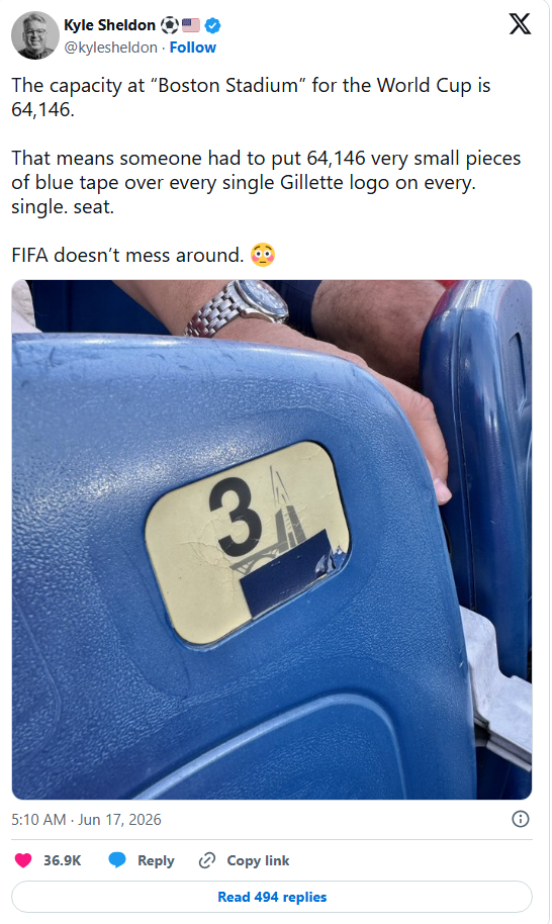
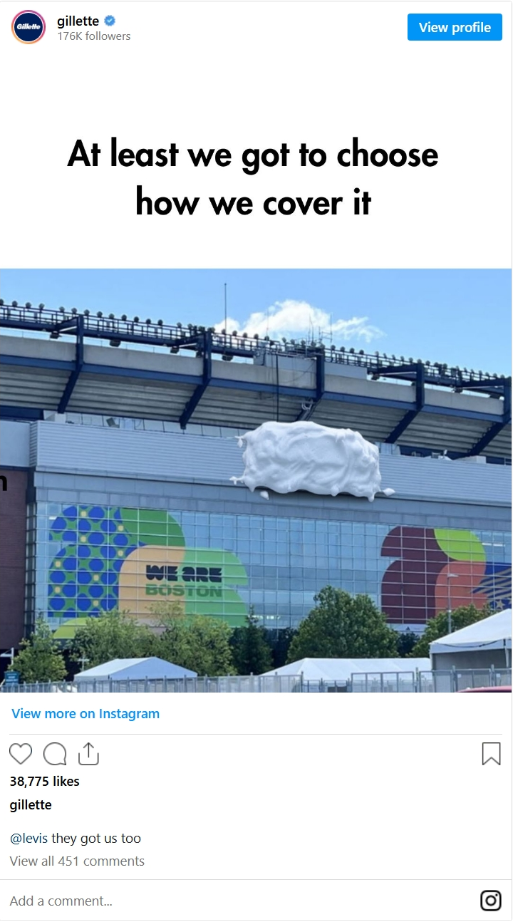
Levi’s Stadium was silently changed into “San Francisco Bay Area Stadium” for the duration of the tournament; its logo and brand identity were removed from public view. This situation could hardly mean anything else but loss of visibility for any other company, but not for Levi’s. They managed to turn even an unfavourable situation into a successful advertising campaign. FIFA’s idea of hiding the logo turned out to highlight the same.
It succeeded because it became widely self-explanatory. The image of the obscured logo alone was sufficient to get the message across without Levi’s having to utter a single word about FIFA, sponsorship laws, and the renaming of the stadium. It provides a unique case of turning a limitation into a campaign. It is not malicious ambush marketing, since Levi’s was not trying to deceive anybody into believing it is associated with the World Cup. Levi’s smart integration of this commercial blockade into their marketing strategy has become a commendable display of creative marketing turnaround.
World Cup stadiums have been asked to cover up sponsors that are not official Fifa partners© Getty Images
Gillette: The Best a Brand Can Get?
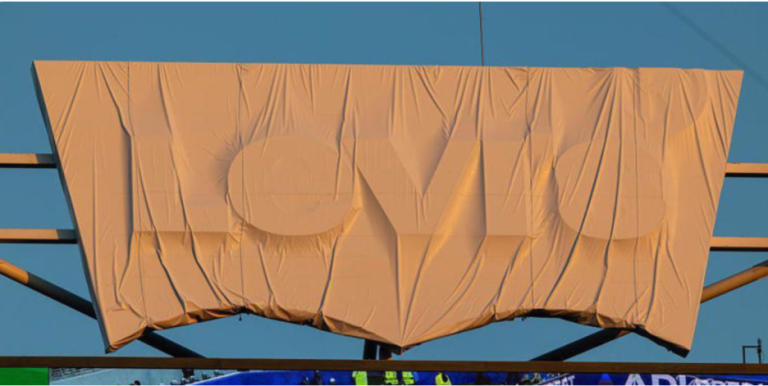
Gillette’s story displays extreme application of the clean stadium policy. Gillette Stadium, the home of the New England Patriots, has been rebranded as Boston Stadium for the duration of the World Cup. Since Gillette is not FIFA’s partner (sponsor) company this World Cup, its logo had to be erased not only from the stadium’s nameplate (Gillette Stadium, Foxborough) but also from the thousands of seats that have logos of Gillette printed on them. Due to the impossibility of removing or substituting those seats in a timely manner, the only solution found was to manually tape the logos.
Considering the scope of such action carried out in a stadium with a capacity of tens of thousands of spectators, one can see how a simple compliance procedure turns into a rather complicated process involving added efforts and costs.
Heinz and the Media Room: “It Couldn’t Be Heinz”
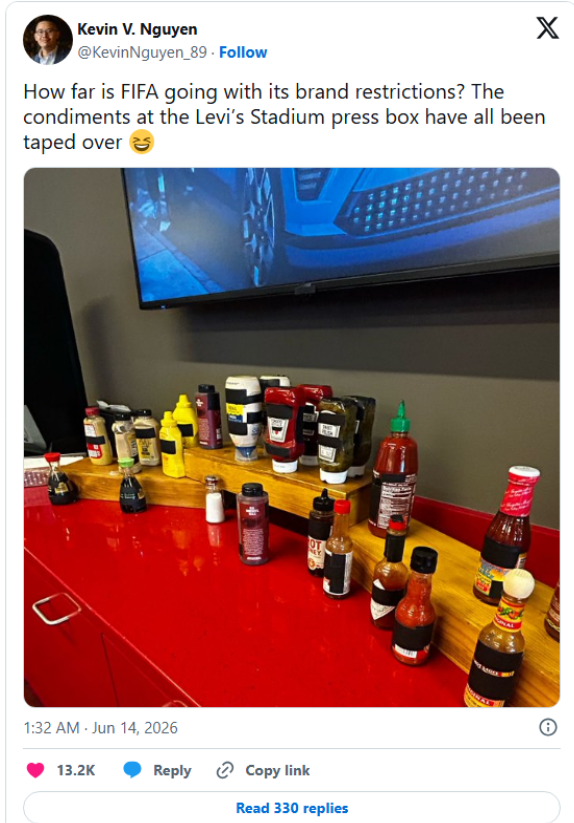
Undoubtedly one of the most underrepresented instances of clean stadium policy enforcement is related to the very basic item of condiment packaging. Sauce bottles and packets marked with well-known brands such as Heinz were covered up using tape in media centres at game venues to ensure that no visible non-sponsored branding would be visible on camera shots.
This example alone demonstrates how the issue is not just about ensuring that sponsors’ rights are safeguarded during the broadcast of the matches – it is about controlling the whole visual environment of the tournament, even to the tiniest detail that is not related to the game, sponsorship arrangements or marketing in general.
Conclusion
Ambush marketing per se is not an unfair trade practice; it does not cause intellectual property infringement by itself. It is a legitimate marketing practice to the extent it does not cross a line that results in commercial losses or invites legal challenges for the user of ambush marketing tactics. However, in instances where ambushers knowingly create consumer confusion, misappropriate registered trademarks, or falsely tend to show official association with an event, then the practice ceases to be mere competitive strategy and becomes actionable under trademark, passing off, or unfair competition law.
The aforementioned case studies portray that the line between clever marketing and unlawful ambush is often blurred. Nike’s gold spikes and Levi’s silent rebranding show that indirect or values-based marketing can thrive within legal bounds, while deliberate deception can amount to infringement of legal rights.
FIFA’s Clean Stadium Policy at the 2026 World Cup shows how far organisers can go to protect sponsorship revenue, sometimes disproportionately. Taping condiment logos or renaming stadiums poses a real policy question: where does legitimate brand protection end and intentional deception begin, especially when the “ambushing” party never intended any association with the event?
Ultimately, the way forward lies not in expanding trademark rights further, but in introducing event-specific legislation that clearly defines protectable “event marks” and distinguishes deliberate deceptive ambush. As global sporting events grow commercially, balancing sponsorship protection with fair competition will remain a central challenge for IP and competition law.
Author: Arshdeep Kaur Dhillon ; Editor: Tanmay Dhiman
This article has been authored by a penultimate BBA-LLB student at the School of Law, Lovely Professional University. It was created during their internship tenure with us.

Leave a Comment