
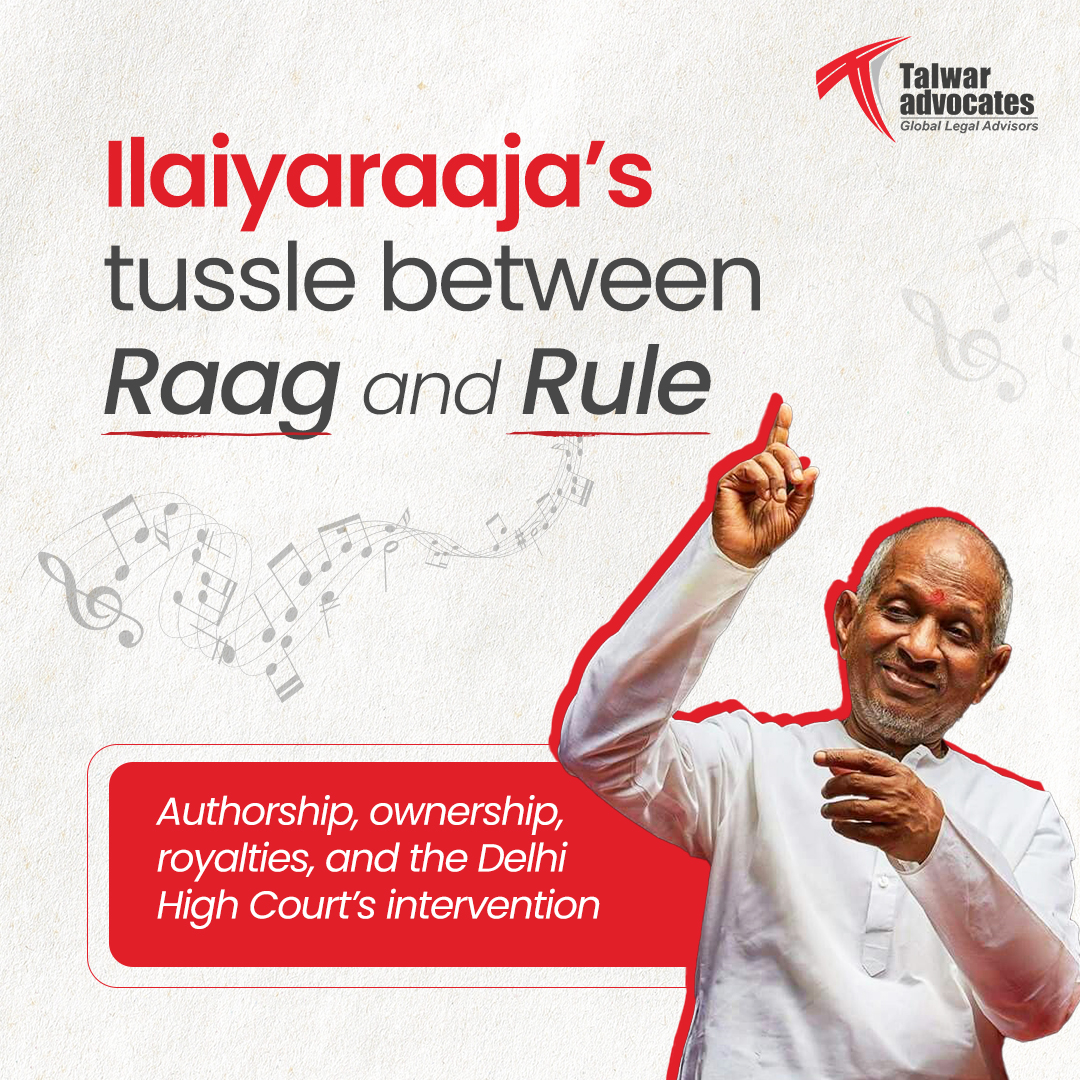
Why this case matters
India’s music industry is once again confronting a core copyright question:
Does creating a song mean owning it forever?
The ongoing dispute involving Ilaiyaraaja, Saregama, and other industry players highlights a recurring legal tension between:
- creative contribution, and
- contractual ownership
For musicians, producers, labels, and streaming platforms, this is more than a celebrity dispute. It is a test of how Indian copyright law operates in the digital era.
Before digital distribution
In the pre-digital era, composers and lyricists often worked under a work-for-hire model. They were usually paid a one-time fee, while the copyright in the musical works was typically owned by the producer, record company, or commissioning entity. Creators were therefore severed from their creations.
Those rights were then frequently assigned to larger music labels, which gained the ability to:
- reproduce the works,
- distribute them, and
- commercially license them in perpetuity.
This historical structure is central to many legacy music disputes today.
Ilaiyaraaja’s long-running legal fight
Ilaiyaraaja has been part of the Indian music landscape since the late 1970s and has, over time, been involved in multiple legal disputes concerning the use and control of his compositions.
One of the most prominent disputes has involved claims over rights in thousands of songs composed across decades, alongside arguments tied to the composer’s moral rights under the Copyright Act, 1957.
These cases reflect a broader legal effort to define where a creator’s rights end and where an assignee’s commercial rights begin.
Why the 2012 Copyright Amendment changed the conversation
The Copyright (Amendment) Act, 2012 significantly reshaped the legal framework for authors of literary and musical works.
The amendment is widely understood as strengthening author protections by recognising that films and songs involve multiple layers of rights, including rights in:
- lyrics,
- musical composition,
- performance,
- sound recording, and
- Production.
Most importantly, the changes to Sections 18 and 19 reinforced the principle that authors of literary and musical works included in films or sound recordings are entitled to royalties for certain downstream uses, and that these rights cannot be easily signed away.
The Delhi High Court’s intervention
In the recent Delhi High Court matter, the Court reportedly restrained Ilaiyaraaja from exploiting certain musical works and sound recordings claimed to be owned by Saregama Ltd.
The allegation was that copyrighted works had been uploaded or distributed on digital platforms without authorisation.
The Court’s interim view underscores a fundamental principle of copyright law:
authorship does not automatically override ownership, especially where contractual rights already vest in another party.
The Real Legal Issue: Authorship vs Ownership
This dispute has revived one of the most important questions in music law:
Can a composer claim commercial control over works created decades ago if the rights were contractually assigned, but later legal reforms expanded author protections?
That is where the tension lies:
- Authors seek recognition, royalties, and continuing connection to their works
- Labels rely on legacy contracts and their assigned ownership rights
The answer could influence how Indian courts interpret older assignments considering the 2012 copyright reforms.
What this means for the Music Industry
This case carries implications far beyond one artist.
- For musicians and composers:
Creative contribution alone may not be enough to establish commercial ownership. - For labels and producers:
Clear contractual documentation remains the strongest defence in copyright disputes. - For streaming platforms:
Licensing chains and rights verification are becoming even more critical in the digital ecosystem.
What happens next
As the matter proceeds, the Court may eventually clarify:
- the scope of rights retained by composers,
- the extent of rights acquired by labels through older contracts, and
- how far the 2012 amendments apply to pre-existing works.
Any final ruling could become a major reference point for music rights management in India.
Takeaway
The Ilaiyaraaja dispute is not just about one artist or one catalogue. It is about a larger legal shift:
How should Indian copyright law balance legacy contracts, author dignity, royalty rights, and digital exploitation?
In that sensed may become one of the defining copyright conversations for India’s music industry.

Leave a Comment